Showing posts with label ecology. Show all posts

Monday, May 28, 2007

THE IN BETWEENERS

Yesterday it was Rachel Carson's 100th birthday. Although she died in the early 60's she's often credited with creating and inspiring the modern environmental movement.

That is of course a very eurocentric way of looking at "the environment", but Carson's writing emphasised that our urban biased "command and control" attitude towards nature had us up to our elbows in the proverbial.

Silent Spring was published in 1962. USA's proverbial was DDT and Carson spelt out its impact in breathtaking detail. One of her prime observations was of urban DDT use to control tree insects, and the gradual residue buildup in our ecosystem.

Our very presence between the forests and grasslands, and the waterways on which our dominant economic model relies is a strange no-mans-land. Marston Bates wrote a brilliant book about the same time as Carson. The Forest and The Sea emphasised the symbiotic relationship of the two, and it is especially in that context that our beloved production system is typically nothing short of "in the way".

The two main nature old timers were Henry David Thoreau and a century later later Ralph Waldo Emerson. Way back in 1854 Thoreau wrote the magical not-too-wilderness account of Walden pond. Thoreau's was a position of observation. So too Emerson's A Sand County Almanac. A lay person in someone elses patch.

Carson and Bates were largely observational but with a little more analysis (they were after all scientists). They had the luxury of observation when our urban presence was perhaps most aggressive.

It was appropriate then that I caught Planet Earth last night on Prime. Rich, rich observation and even richer imagery. In no way does this detract from analysis of the seemingly simple but amazingly complex system that is our biosphere.

It seemed to me a perfect way to end Carson's birthday, and of course to reflect that our in between-ness requires a whole lot more respect of the planet than we generally show.

Some advice: catch Planet Earth next Sunday on Prime...

Tuesday, December 05, 2006

TO JB OR NOT JB
I spent the weekend on the south Wairarapa coast with a bunch of friends. On Sunday we came across a dead sperm whale washed up at Whatarangi.

"JB" had been there before us. JB, whoever she or he may be, had seen fit to carve those initials in the thick sunbaked skin of the dead mammal. You may be able to make it out at the bottom of the photo (courtesy Dion Howard, photographer extraordinaire).

JB did not have the same experience standing beside that whale that I did. But how different is JB's world view to mine? Why did JB do this?

Until now only my girlfreind, my parents, the (then) local constable, and a childhood friend knew this: when I was a kid - 8 0r 10 years old maybe - me and a buddy ringbarked some young silver birch trees in a local park. We got nicked and I will be forever ashamed of that act. Ashamed then primarily because we got nicked, ashamed now as I can't believe I didn't appreciate the value of a tree. Why did we do this?

If JB was simply getting down with the whole tagging thing I can see that s/he may have thought "a whale's as good as a wall". By carving on the whale JB was making no lasting physical impact. I took the life of a tree.

My buddy and me were young, and no doubt so is JB. I an early post I wrote of some Cornell University research that found:

If you want your children to grow up to actively care about the environment, give them plenty of time to play in the "wild" before they're 11 years old

I now care, maybe the fact that JB was out "playing" on a remote beach means that s/he will one day care. Or is there something fundamentally different between JB and me? I found myself looking at the whale and feeling an appreciation of the scale of loss. It may have something to do with whales sharing human traits. The dead animal demanded respect.

I've implied that my killing a tree is of less consequence than JB's tagging of a (presumably) dead whale. My implication probably comes from the fact that you can simply rock up to a garden centre and pick up another silver birch plant - it is a commodity. Try picking up sperm whale at your fishmonger - you're not in Iceland now Dr. Ropata.

What prompted JB to "own" a piece of a whale? Is it nature deficit disorder? A simple dis-connect from nature? It's late and I don't know the answer - but it's sure worthy of some thought...

Wednesday, November 29, 2006

GREENING OF THE KEY
Wellingtons "Greening of the Quays" project is designed to lift the appearance of a dull concrete barrier between a wonderful waterfront and thousands of CBD shoppers and office workers.

Will the greening of John Key and New Zealand's National Party lift the appearance of their dull policy barrier? Will it bring the environmental quality of our wonderful planet to the explicit attention of the hundreds of thousands of National voters?

Yesterday Key outlined some of his "core principles" to drive his leadership - including the following statement:

"It is a mystery to me why the political Left acts as if it has a monopoly on environmental policies, when it is obvious to anyone who cares to look that all of us, across the political spectrum, with the exception perhaps of the Greens, have taken too long to put the protection of our environment at the forefront of our thinking. That needs to change. In the National Party we have taken steps to do this, and we will be taking more steps."

"[P]rotection of our environment at the forefront of our thinking" - something I'm looking forward to seeing clear indication of. Just how will the much vaunted Blue-Green vision for New Zealand play out. Especially as National will most likely steer our good ship following the 2008 general election.

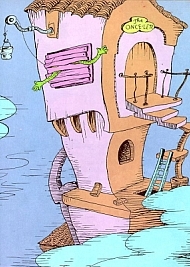
Two similarities spring immediately to mind. First, to David Cameron the British Conservative Party Leader who lurched greenward after winning party leadership late last year. Second, and this would apply to both Key and Cameron, similarities to The Once-ler in the iconic Dr Seuss story The Lorax are abound.

The Once-ler had become a recluse (unlike Key) having pillaged the landscape in order to make his fortune. At the end of the story The Once-ler offers the very last truffula tree seed.

"Plant a new truffula. Treat it with care.
Give it clean water. And feed it fresh air.
Grow a forest. Protect it from axes that hack.
Then the Lorax
and all of his friends
may come back."
Was yesterdays speech to party faithful the peace offering of the Once-ler? Is his audience able to embrace the seed and "treat it with care", or has all the "figgering on biggering" consigned the political right to eternal myopic inertia?