Showing posts with label booze. Show all posts

Wednesday, April 11, 2007

WELLY WORD

Yesterday busways, and then today there's this, 40km's of extra bus lanes in Wellington.

If you live on a bus route in Kilbirnie, Hataitai, Island Bay, Brooklyn, or Karori you may just get the perfect excuse to arrive late and leave early from work.

Then again, your next best late excuse may about to dry up. Literally. The Bodge is for sale (h'tip Wellingtonista). Bodega is one of the more worthy Wellie institutions - lets just hope that someone of muso slash ale persuasion steps up to the plate.

Sunday, February 18, 2007

GIN IN A SLING
"Of course they've brought forth juniper berries! They're juniper bushes! What do you expect?" But maybe the British can't expect for much longer.

This line is from a wonderful scene in Monty Python's Life of Brian where Brian is pursued by a maniacal band of worshipers. Hungry, they think Brian has given them a miracle of food. But he's turned the horde to a juniper bush owned by Simon - a recluse whose 18 year vow of silence Brian broke by jumping on his foot.

Simon's only form of sustenance was the juniper berries.

Although most gin these days is flavoured by berries grown in Italy and Eastern Europe, the British juniper bush is under threat.

The juniper bush "harbours about 40 species of insects, and is one of only three native conifers" in Britain. If Brits drank local gin I suspect that demand for berries would keep the bush alive.

Thursday, February 15, 2007

MATCH MADE IN HEAVEN
With all this biofuel talk the last few days, and my penchant for banging on about beer, I couldn't miss this chance: a US microbrewery is partnering a biofuel company to make biofuel from algae.

Helen wants to see 3.4% of all vehicle fuel pumped in New Zealand to be biofuel. And those with their ear to the ground will of course know that Aquaflow (of Marlborough, and mentioned here last month) have already road tested biofuel from algae.

But this is even better! The US brewery are "providing CO2 - a byproduct of fermentation and boiler operations - that helps the algae grow. After several weeks, the microorganisms are harvested and their oil is extracted and refined into biodiesel."

Making biodiesel from algae may help quieten criticism levelled the poor overall efficiency from plant based ethanol. Brasil it seems is one of only a few places where net energy gains from "standard" biofuels gan be gained.

Not only is it good to see a technology being advanced that's also being developed in NZ, it's great to see beer by-product being used. Cleaner production is a good thing.

This is yet another example of carbon offsetting. Offsetting directly, rather than paying someone else to deal with the issue, is just the path progressive businesses need to be looking at. Our dairy industry has a steady supply of milking shed shit that goes unused. Wine and beer makers usually trash their production waste. Wine and milk are often located in centres of production - so there are concentrated amounts of by-product for use. Martinborough and Canterbury for wine and dairy biofuel respectively makes sense to me.

Regardless, imagine driving your biofuel powered car to the bottle store along a road made from recycled glass to pick up a crate (along with the rest of your shopping of course). You'd be inclined to think you were making a difference!

Friday, December 08, 2006

MESSAGE IN A BOTTLE
There are empty bottles strewn everywhere. So the Greens and the NZBCSC have kicked up a stink about how tough it is for roading contractors to include recycled glass in road aggregate.

It’s the latest spat in trying to find a solution to the glass mountain that I’ve posted about previously. Just last month a beverage industry spokesperson scorned calls for introduction of a compulsory bottle deposit.

His was the classic short sighted economic argument: consumers should not be penalised for the fact that the recycling industry can’t make glass recycling work. No mention of the fact that councils and ratepayers typically subsidise beverage companies by footing the cost for disposing of single use packaging.

The argument is one of life cycle costing for glass. The Greens and NZBCSD press releases show that councils (and their roading contractors) are not prepared to factor in the saved landfill costs when deciding whether to mix glass with roading aggregate. And there's stacks of unused “recycled” glass available.

Late last year more than 2,000 people signed a bottle deposit petition that a Motueka community group submitted to local councils. Nothing substantial came from councils, but the same community group are now part of the Great New Zealand Bottle Drive – a campaign to establish container deposit legislation. South Australia has been operating under such legislation for many years, and so have 11 states in the USA. The Canadian territory of Ontario is considering it.

Of course the glass mountain wouldn't be an issue if there was no need to recycle bottles – if all beverage bottles were reused. Like those you use when drinking beer from a crate.

I’ll say it again: if you’re after a beer at a bar then ask for it from the tap. If there’s no tap don’t consider it your local. Your average sports or working men’s club, or your local RSA will probably have tallies (from the crate). They just happen to serve them at a fine new establishment upstairs on Cuba Street. Crikey, would you look at the time…!

Update: 21 March '07 - Duncan of Community Action has informed me that over 25 councils have now got behind their push for CDL - including Wellington City. Great work!

Monday, September 18, 2006

THE "CLINK" OF GLASS
My flatmate's parents were up from Christchurch a few weeks back. In their carry on luggage was some local beer.

We finished what was left of the quite tasty Wigram Brewing Co. dark lager last night. One of the "tricks" of micro brewing seems to be coming up with a quirky label. I was checking it out and noticed (in addition to the flying theme) that if you take your empties back to the brewery (Sonter Rd, ChCh) you'll get 20c per bottle back. Nice!

As I've posted about before, glass recycling is a real problem in New Zealand. We should be drinking our beer from the crate or a tap, but if we can't, returning bottles to the brewery is still better than putting them out with the kerbside recycling. At least until expansion of that Auckland glass plant happens.

As it turns out the Three Boys Brewery of Christchurch also runs the same refund deal. If you're living down in the flatland it's worth stockpiling and pooling resources with your mates. You'll get a better deal than Sth Australia's 5c refund program.

Although it seems that environmental consideration was not important, Three Boys also won the "Packaging Award" at the recent BrewNZ event. Wigram won the dark beer and specialty beer categories. Only two bronze and two silver for my much loved Tuatara Brewery.

If you're like me and over summer red wine consumption tends to drop off in favour of beer, you'll end up using more glass. Think about where it goes when you're done. Buy a swappa-crate. The more of us that do, the sooner the gawd-awful range will improve. Cheers!

Thursday, August 03, 2006

62 ABOVE
Would this speed up or slow down sea level rise? Yesterday the beeb reported that the town of Narsaq in Greenland is melting chunks of its' ice cap to brew beer. That's what I call interesting news!

I suspect that if I were to dash down to the offie, grab a case of the stuff, savour it, and emit what the body didn't need; the moa point plant would discharge to sea faster than if it were left in the greenland ice cap. Or is the cap melting so fast that it's no contest?

A stupid question of course. The key issue is (glass recycling aside) sustainability of water source, and consequently, if I were able to buy it at my local would I be supporting the accelerated destruction of one of the planets life sources?

Are they taking melt water, or are they taking ice? My Kalaallisut isn't so hot, so I have no easy means of getting sustainability info from the brewery website, and the BBC article is of no help.

Berg beer was done around the turn of the century apparently (...ooooh, its sooo last century). But this time round, rather than selling at sipping prices (three stubbies for $26US), this batch looks to be more of a quaffing drop at 5Euros a half litre. So the impact may be a little more substantial.

It was quite timely news for me. Last night I saw The White Planet at the NZ Film Festival. The beauty and fragility of the arctic neck of the woods is all too fresh in the mind. Surely drinking beer from a much needed and melting ice cap is more than a bit excessive...

Monday, March 27, 2006

"A CRATE OF THE GREEN STUFF THANKS GUV"
Have the glory days really gone? Back in my late school and early uni years there was an annual event that celebrated a Kiwi icon. Crate day was a bit of blokey boozey fun that many of you will relate to. There is still the odd crate day held around the country, although I'm sure it would be rare to see the same enthusiasm as displayed by some of my buddies "back in the day"...
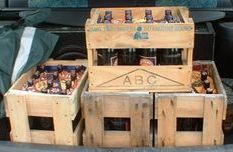
Now binge drinking is not an activity to condone under any circumstance, so the reason I'm writing is that the love of the bottle has a pretty significant environmental pitfall. Until recently I'd enjoy a bitter from a pretty little bottle that came in cardboard. The problem with that is waste. Sure, we can recycle the glass (and the board), but it turns out that the glass doesn't get much further than the landfill. So
I've again taken to the "real" bottle. The 745ml variety that comes in a crate you can swap at the bottle store.

During the early part of 2005 New Zealands major glass recycler reduced the price they pay
Councils for the glass they return for processing. The price for cullet (as its called) was dropped from $92 to $10 per tonne. A big reason for this decision was that recycled glass had to compete with the cheap imported bottle glass most bottlers use. Problem: at a return of $10 per tonne it is too costly for Councils to send collected glass to Auckland for recycling. For a while the liquor industry was paying a levy to keep recycling viable, but now that agreement has expired bottles invariably sit in the yard at local landfills waiting for councils and industry find a long term solution.

Clearly then, as consumers "on the bottle", an obvious individual solution is to embrace the crate. However, if you find this
concept a little too "Bruce Bayliss", at least ask at your local where the glass you're buying comes from. If they don't know ask them to find out for your next visit. If its imported glass you're supporting the market that created the problem. And when you're out at a bar, order tap beer. Not only is it fresher, its also better for the planet.

So go on, embrace the crate... but always remember what Len Ring had to say...