Showing posts with label policy. Show all posts

Friday, June 08, 2007

HYPERVENTILATION

Following up on Sundays "...carbon ...breath" post, the Wellington City Council last night agreed to "recommendations that will see the Council and the city embark on a path to carbon neutrality."

Over at WellUrban there's a little pre decision context for the Councils' aspiration - including a call "not to be too cynical". Yesterday however, the contents of my mailbox introduced a little cynicism. ShoppingFix was declined funding by the councils environmental grants sub-committee.

When the council states "...consumer choice, transport methods and innovation all have a place in how Wellington achieves carbon neutrality", one wonders why our sustainable shopping resource has no fit.

We were criticised for having no "clear standards and... monitoring process", and for proposing a process that would see "certain businesses being promoted over others".

The ShoppingFix concept of stakeholder accountability rather than traditional standards was lost on the committee. As was the logistical difficulty in engaging with every Wellington retailer simultaneously. While reading the committees decision I wondered just how the Council chose the paper supplier that ultimately enabled them to advise us of their decision. Will hypersensitivity toward nepotism prevent Council from engaging with the logistics of carbon neutrality?

There is of course a hint of sour grapes in my tone. The ShoppingFix application was not articulate enough. Given that we're angling heavily at Councils recognition of "consumer choice... and innovation" as key pillars for carbon neutrality we need to communicate our concept better.

Council staff have until September to "suggested projects and initiatives that could support" options for emissions reductions. The ShoppingFix concept will be suggested to staff as one such initiative.

Sunday, June 03, 2007

"I CAN SMELL THE CARBON ON YOUR BREATH"

It's hardly the Oxford Union Debate, but Wellington City Council will on Thursday discuss whether they'll aspire to be carbon free.

Although it's merely an aspiration, if set it'll place our fair city on a path that brings carbon accountability into all WCC policy. Although council emissions increased more than 8% in the three years to 2006, they've some handy emission reduction initiatives.

Kai to Compost has shown that commercial food waste can be dealt with - reducing dangerous methane landfill emissions. The programme just needs to scale up. They're also making a significant planting contribution on Arbor Day.

Other cities have stuck their neck out
:: Newcastle (UK) aspires to carbon neutrality
:: Norman Foster is to design waste and carbon free Madsar in the middle east
:: In February the Chinese government unveiled grand plans for an island near Shanghai
:: Malmo in Sweden is also on a carbon neutral path

This weeks meeting is a step in the right direction for Wellington. Can we walk the talk?

Thursday, May 10, 2007

ALL ABOARD...

2.51 million flights are scheduled to depart worldwide this month, and the New Zealand Herald reports that "binge flying [is] killing the planet".

As the IPCC assessments have shown, we're far from immune from the impacts of climate change in NZ. The impact is of course partly economic. Our biggest tourism market has the yips: 18% of Aussies are considering not flying. Ever.

The Listener covered the potential impact on our tourism market back in March. In pointing out the polluting problems of flying, the author notes that "jets consume eight times the fuel that trains do travelling the same distance". But what about solutions?

Rather than bridging the Tasman, our tourism sector needs real answers. Air New Zealand have ordered a quick fix or three - a bunch of fuel efficient planes. But that's simply applying duct-tape to the problem.

The Listener mentions carbon offsets. Air New Zealand have "looked at, and discounted" offering these to customers, although customers can always buy direct from any of the multitude of providers.

Brian Fallow discusses polluter pays emissions trading (ETS) in the Herald this morning. He notes that there is no fuel or sales taxes imposed on any international flights (anywhere) and rightly sees that the NZ aviation market is ripe for being placed under the NZ ETS being considered by government. Hardly the environment for a new airline you'd think.

It's clear that New Zealand must future proof it's biggest export earner. Our tourism earnings will be flavoured by climate change policy. International visitors to our shores are more carbon aware by the day - our aviation industry's position in a national economy where carbon is priced is crucial.

Thursday, April 19, 2007

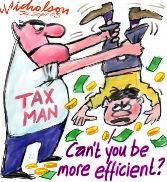
CARBON PLAY: TAX OR TRADE

I've echoed global and Kiwi business calls for a price on carbon before. Pricing carbon is a key means of reducing greenhouse gas emissions. As businesses strive for cost efficiency, there is direct incentive for them to address carbon efficiency and thereby lower emissions.

In New Zealand a big reason for pricing carbon is to provide investment certainty. The situation has been clouded ever since farmers marched on Parliament in 2003 to quash the "fart tax" proposal.

The two options for pricing carbon are invariably a cap and trade system or taxation. Last week a report sought by Business NZ and some of the largest GHG emitters in New Zealand was released. It strongly advocates cap and trade over tax.

Businesses able to pass the cost of carbon to their customers should buy emission permits. Those "at risk from international competitors with no similar obligations" would be "given" permits so long as their operations met international best practice.

Elsewhere, in March the Greens came out with their "framework policy for climate change". Its cornerstone is a carbon tax levied where carbon enters the Kiwi economy. So unlike GST, and unlike the Governments back peddled 2005 carbon tax, there's no explicit extra to pay at the till.

Both the Greens tax idea, and the latest big biz idea will heavily favour clean energy generators like Meridian.

Brian Fallow - biz writer at NZ Herald - has summarised current sentiment particularly well. He points out that our tiny emissions profile dictates that big countries like US and China should move first. He also notes that we shouldn't impose cost on biz before our major trading partners do.

This is the particularly self interested perspective of business - but not particularly surprising. Crucially, it has a sense of prolonging the inevitable. Even a sense of "head in the sand".

Some perspective can be found in an interview on National Radio's Our Changing World a few weeks back. VUW's Dr. Sean Weaver explains (audio, 8 or so mins in) that global carbon trading activity is presently akin to pre season training for when Kyoto kicks in next year. That's when Kyoto nations become liable.

Notably, Dr. Weaver points out that voluntary carbon markets (in Oz and US in particular) are equally active in allowing businesses to benefit from being more carbon efficient. Trading activity effectively provides businesses with "environmental responsibility certificates".

By imposing a carbon tax, the NZ Government may well deem carbon trading redundant for our businesses. But a key advantage of tax over trade is that there's less leakage. Potential for leakage demands that the tax is imposed where carbon enters the economy (like the Greens proposal) where carbon measurement is easier and more cost efficient.

With trading, each individual company that wishes to engage must measure their own emissions in order to obtain a quantity to trade. There's not only room for error, there's room for creative carbon accounting that can skew outcomes.

Pricing carbon (with either tax or trade) gives our businesses direction. It will give a potential market incentive to mitigation technologies like those being advanced at Landcare Research. It will also give our export markets the increasingly called for assurance that Kiwi producers are addressing emissions.

I for one support a carbon tax. The NZ Government will come up with its solution "soon". Which way will they go?

Backgrounders:
Carbon trading 101: Dr Sean Weaver on National Radio (audio).
Gristmill: kickin it with cap-and-trade
Alternet: the problems with cap-and-trade
Gristmill: tax-and-trade - why not both
Carbon Tax Center: blogging the benefits of carbon tax
Pigou Club: more on the benefits of carbon tax

Thursday, March 15, 2007

STOLEN THUNDER

Costa Rica is drafting plans to become carbon neutral. Not that the boss said New Zealand would do it first, but it does steal her thunder a little. Other nations are neutral - but they're not the most productive contenders.

Comparing NZ and Costa Rican potential for carbon neutrality initially seems like comparing apples with underpants.

But we do have similar populations, a similar proportion of GDP from services, and we each have about a quarter of our land area protected as parks.

Significantly, New Zealand consumes about three times more oil than Costa Rica and although we're both rich in hydro power we still use fossil fuel for a quarter of our electricity generation. For Cost Rica it's 1.5%.

CO2 emissions per unit of GDP is lower in Costa Rica and per capita emissions in NZ are six times higher.

So are Helen's CO2 neutral aspirations indeed pure rhetoric? Costa Rica certainly have a more likely carbon neutrality ambition without offsetting. We're a spread-out country with fossil fuel dependency.

For me the most telling stat is oil consumption per unit of GDP. Costa Rica uses 44,000 bn barrels per day to generate GDP of $49bn. That's a ratio of 0.9 - ours is 1.4. We're more than 50% more oil thirsty than Costa Rica.

Costa Rica is famous for constitutionally abolishing its army in 1986 - probably why they're the third happiest country on the Planet. Happy punters are more likely to accept policy measures necessary to achieve carbon neutrality. Or maybe it's as simple as having a little more at stake...

Tuesday, March 13, 2007

ON THE BOTTLE

Container deposit legislation (CDL) has hit the headlines again. I've posted about it reasonably frequently - most recently in December when I highlighted the Great NZ Bottle Drive campaign.

The Packaging Council have replied to the latest CDL push - citing their own research findings that CDL would cost up to $121m p.a. They state that this cost far outweighs the cost to councils for kerbside recycling.

In my opinion this is a cost to the environment that the "containered" products themselves should bear. At the moment we as ratepayers (directly as property owners or indirectly as tenants) pay for the cost of recycling yet large amounts of packaging that could be diverted still get landfilled.

Any increase in cost will probably be passed to the consumer. But as I say, these are the real costs. Producers that are able to implement the most efficient means of collecting their returned packaging will be more price competitive. It's a classic example of efficiency through economic incentive.

Aside from cost, much of the industry criticism of CDL is founded on logistics. "Shops have insufficient space to store returned material" - I agree. "Food standards mean that containers wont be re-used" - I agree. But these arguments are based on looking at business as usual. CDL is yet another example of attempts to change the way business is conducted.

Much external infrastructure exists that can be utilised by those that will need to process the extra material. Councils contract out recycling services. Why can't industry do the same?

It's simply not good enough to accept sending usable "waste" to landfill. Voluntary mechanisms such as the Packaging Accord have been very limited in their success. Mandatory measures backed with an accurate economic framework make sense.

Update: 15th March - Business NZ say the "Waste Minimisation (Solids) Bill [is] an overreaction to the issue of waste. And that "Industry-led solutions for specific waste management issues and improved education are better alternatives." Yeah right.

Wednesday, February 21, 2007

ENDURANCE RACE ALTERED FOR ZIMMER FRAMES
I can see the story now; "the 2008 Coast to Coast course will be radically re-designed to improve accessibility." It's not out of the question if yesterdays report is escalated.

The Federated Mountain Clubs of New Zealand have quite rightly pointed out that DoC is "attempting to make the mountains safe instead of encouraging people to make decisions." DoC want to highlight the risks of tramping with signage placed numerously and conveniently along trails.

Issues of signage and safety have emerged following the deaths of two inexperienced foreign trampers in recent years. Interestingly the news source claims that family members (in England) "helped identify the risks of climbing in the Mount Aicken area". Clever people those English.

This article on sheep rustling in Devon gives an indication of the concepts of scale and remoteness held by some English. So yes, the New Zealand back country would seem an extraordinarily inhospitable place for many. But it's no basis for installing traffic lights along the Mingha-Deception.

Naturally we have sympathy for the families impacted, and for DoC's direct role in reflecting that. But nanny state criticism has grown during the current Labour Government term. Increased track signage seems another "there there my dear" intervention. According to the Mountain Clubs

"such changes have the potential to reduce, rather than improve, safety for inexperienced people, while diminishing the quality of the mountain environment for more experienced users. High-quality tracks can lull the unwise and unwary into a false sense of security."
It's just as well that DoC have no mandate for signage in Auckland retail areas.

Sunday, February 11, 2007

MONEY THAT GROWS ON TREES!
Last week a British ethical investment fund outperformed "the market" for the first time. And easily.

The Co-operative Bank is a UK ethical banking stalwart. They're customer owned - like PSIS. One of their funds has taken top spot in the UK All Companies sector - outperforming the sector and also the FTSE by more than 100%, and clocking a three year return of 88.6%.

Not surprisingly, here in New Zealand our ethical investment market is a lot less mature.

In fact the NZ Government was pounced on by the Greens last week for investing Super Fund cash in nuclear and cluster bomb weaponry manufacturers. It's reminiscent of the LA Times Gates Foundation expose last month highlighting their investment in companies directly linked to the causes of health problems they sought to alleviate. The publicity prompted a Gates Foundation review. Our Government is to do the same.

The real problem is that the economic basis itself is fundamentally flawed. Over on FrogBlog last week the old "perpetual growth" conundrum was aired again. "Business as usual" is founded on resource use that seeks to contribute constant growth in order to pay constant investment dividends. Constant growth based on a finite resource base is bound to turn pear shaped.

We're seeing the start of the crunch now with climate change and peak oil. Technology can only help us along so far. At some point we've got to change the way we "do business". The term decoupling is sometimes used in the context of economic growth and it's relationship with GHG emissions.

FrogBlog uses demand for energy as an illustrative example:
"...if NZ electricity demand were to grow at 3.5% per annum we would need to double our generating capacity every 20 years. This would be a major challenge."

Maybe we need a decoupled investment fund. The Co-op bank in UK and Prometheus here in NZ are more "decoupled" than the typical investment offering. And of course if ethical investment products pull in business that would otherwise go to standard funds we're moving in the right direction (remember the Aquaflow offering).

As more of the environmental and social costs of "business as usual" are internalised, ethical investments can expect to outperform the market as a matter of course. As cleaner business becomes the norm the concept of a diversified portfolio will start to make financial and ecological sense.

Update: in another move toward a pigovian tax environment, the NZ Greens have proposed that companay tax shifting occurs in order to incentivise cleaner production.

Another update: there're some quality comments in this subsequent Frogblog post - including from a fund manager.

Thursday, January 18, 2007

LAND BANK
Last week a British conservation charity announced the purchase of 3,600 ha. of land in the Pantanal - the planets largest wetland that spans Brazil, Bolivia, and Paraguay.

I spent three weeks in late 2001 visiting a friend living in Bonito, Brazil - bordering the Pantanal. It's a spectacularly clean, bountiful, and serene place. The photo (left, from flickr) could easily be one of the many fish I swam with in one of the countless crystal clear streams. The Pantanal is so worthy of protection.

The British charity hopes that its purchase will help save a large area of native vegetation from being cleared for agriculture. With similarities to vast areas of the Amazon basin, the Pantanal has lost approx 17% of it's native cover - often to soy production. The purchase is the latest in a long line of high profile South American land accumulation projects in the name of conservation.

Names like Soros, Benetton, Stallone (yes, the sly one), Chouinard (of Patagonia clothing fame), Ted Turner (CNN), Doug Tompkins (Esprit, North Face) are etched in the land holding annals of rural South America. Mostly in southern Chile and Argentina where the winds are wild and the peaks snowy.

But many locals see protection through foreign ownership as a dangerous ceding of sovereignty. Some even see it as a direct consequence of aggressive US foreign policy. Numerous attempts of "re-nationalisation" have occurred.

Criticism of the situation in South America has some remarkable similarities to the high country land tenure review process here in New Zealand. One commentator says "natural heritage [is] being robbed" in a process where the government decides to either buy or sell leased farmland that comes up for lease renewal.

The logic is that the government holds ecologically important land (for ever), and the farmers hold the arable areas. But when the government decides to buy, the price is often criticised as being too high, and when it sells, the price too low (numerous views on the tenure review process can be found on Scoop).

In addition to conservation, the similarities between tenure review and South American eco-philanthropy include loss of iconic landscapes to private ownership. In New Zealand a tone of impending development is often taken by those reporting on the issue. Whether that be correct or not, the same base fear exists - "what if we loose land/landscapes forever?"

Topically then, foreign ownership of New Zealand land is explored in a film appearing briefly at the Paramount next week. The Last Resort will screen for one week only. It touches on (apparently) the loss of iconic kiwi landscapes and lifestyles. South America may be experiencing colonisation by philanthropists, The Last Resort is pitched as exposing "colonisation by corporation".

Update 8th Feb: the Guardian has more criticism of South American eco-philanthropists. "...Argentinian press has suggested [Doug] Tompkins might be a covert CIA operative securing US access to the aquifer." ...all righty then....

Wednesday, January 10, 2007

PAINT BY NUMBERS
I'm partial to banging on about numbers. The business case for engaging with sustainability principles is a case in point.

One good thing about numbers is that they often allow the painting of a simple picture of complex issues.

The argument surrounding binding environmental targets is for me a clear indicator of where numbers prove practical.

The Kyoto Protocol binds ratifying nations to an emissions target. The US and (largely) Australia reject binding targets. The limited impact of the voluntary NZ Packaging Accord mirrors that of voluntary industry led initiatives elsewhere. Whether it be emissions or waste or both, numbers usually point to mandatory obligations being the only real means of lowering impact.

Last week the Herald reported that nearly 80% of Kiwis "believed they needed to make lifestyle changes to reduce global warming". Labour (and whoever runs the show from 2008) have numerous polls to call on. Mandatory obligations on our producers and consumers are not the political hot potato that they once were.

Voters now accept that they need to make change - so economic incentives to promote pro-environment behaviour is sensible. Public opinion is clear (790kb pdf) and studies advocate a mandatory approach. Government can and should (en)act.

Monday, July 10, 2006

SHIFTING Vs SIFTING
In an interesting aside to my last thread, an "informal" poll at a small regional UK public body gathering late last week indicated that more recycling would lead to higher council tax (rates). Apparently "the public will have to get used to paying fees for enhanced services". There is of course scope to explore tax shifting within this framework, but it's clear: there's a gap between what tax/rate payers expect and what councils can provide. I guess that's why we have a user pays economy...

Thursday, July 06, 2006

SHIFTING WASTE (AND TAX)
Several British media outlets reported this week that a vast majority of Brits would accept a tax levied on non recyclable household waste. The argument is that if councils can decrease the volume (and therefore cost) of waste they have to manage, they can charge a lower Council Tax (our equivalent of rates)... a classic example of tax shifting.

So rather than squeezing more out of consumers (as was the argument used by opponents of the NZ carbon tax), those who are able to reduce kerbside waste are rewarded for putting some thought toward their "throw away" shopping mentality. Take from the bad to give to the good.

Although New Zealand is heralded as the clean green paradise our habits suggest otherwise. We throw out about double the amount of domestic waste per capita as Britons and around six times as much as many European countries where household waste is currently levied. (I'd like to be proven wrong on these stats, but they're the best I can find.)

It is timely then, that the Greens waste minimisation bill got drawn from the ballot a month or so back. We need to address solid waste now, and unfortunately it can't be addressed by the market. The bill places emphasis on product stewardship (producer responsibility) - in recognition that voluntary measures such as the Packaging Accord have been a failure. So we could eventually see here what is apparently commonplace in Germany. Supermarkets where you fill your own container for many products.

As it is, those of us who do make an effort to reduce our rubbish in effect subsidise those who waste indiscriminately. So why not send an accurate economic message by changing the rating focus...?

Thursday, March 30, 2006

HOLY HOCKEY STICK BATMAN!
This week I have had the pleasure of attending the Climate Change and Governance Conference here in Wellington. As the organisers said, it was a unique event for New Zealand as it was the first held in a setting where human induced climate change was accepted as fact.

I was however reminded of my letter to the editor of North & South - published only last November - where I had a crack at them for publishing a pre-election climate policy commentary from one Augie Auer. Auer - a meteorologist writing as a "climate expert" - started with "... first of all the Earth is not warming catastrophically." Auer then proceeded to justify his stance with a discussion of Kiwi weather. No word of climbing temperature and CO2 levels - no mention of the famous hockey stick shaped graph curve. And thats all I'll say right now about the media and environmental issues...

Anyhow, the conference had many an impressive speaker that collectively provided a timely reminder that our Government needs to provide clear policy direction. NZ business relies on strong policy in order to make investment decision, and ultimately policy will impact us as consumers as we are at the heart of our economy. I thought a key point made was the recommendation to establish a multi-party process to set policy. It's an obvious step with a good chance of producing policy to break through the political cat fighting that presently has us in no-mans-land. Our MMP setting means that policy established cross-party is a must.

The conference has come at a time when questions of climate change are in the news. Cyclone Larry, Westport water shortages, Matata cleanup, and the current Time Magazine. If you are still in doubt whether human induced climate change is real, just ask anyone from the insurance industry.

Climate scientists call it mitigation, we lay-people can simply see it as "how can we make a difference". ShoppingFix will provide a tool to make simple everyday decisions that contribute to emissions reductions. Supporting businesses that are energy efficient, that avoid intensive resource use where possible, and that treat the earth with the respect it deserves. Government has been unable to provide a setting for business to create tools, but ShoppingFix is happy to step in. In thinking about what we can do, I'm reminded of a scene from The Life of Brian (yes, the best film ever made). A rather satisfied Brian addresses the people from his balcony: "You've got to think for yourselves, you're all individuals!"

A valuable post conference event was a film and discussion evening at Paramount Theatre. 500 Wellingtonians showed up, paid their $10 and bounced comments and questions off David Vaughan who sits on the IPCC. If you're in ChCh tonight I urge you to go and listen to Lord Ron Oxburgh (ex Chair of Shell) at the Town Hall 7.30pm (its free). The Wellington conference, the Paramount event, and the Oxburgh talk are all crucial opportunities for us to get objective climate change information. More information will lead to better individual decisions. If the politicians cant provide leadership, as consumers we certianly can.